July 2026
A fruit seller in Hanoi, a team formed over one Atlanta weekend, and how a language app changed shape on its way to a 2019 acquisition.
The first version of this story appeared on TripLingo's website in 2014. It ended with a line that was practically mandatory for a startup at the time: “We're just getting started.”
In our case, it was true. We were three years in. We had released three major versions of the app, passed 200,000 downloads, and started working with large travel companies and corporate customers. But that original story could not say where things eventually went: five more years of building, an acquisition in 2019, and another four years for me inside the company that acquired us.
This is the longer version.
The problem was personal
For nearly two years ending in 2010, I lived, worked, and traveled across ten countries in Asia. I spent about 18 months in Vietnam, where I worked for the country's Caterpillar dealer, followed by six months in India.
Vietnam taught me very quickly how limiting it is to know none of the local language. I'm not sure you've ever asked where the restroom is using only your hands, but it's just a tad embarrassing. Everyday plans became harder than they needed to be, and even when I could get where I was going, I had little sense of the culture I was now living in.
I looked for something that could help. The available language products tended to be expensive, impractical, or designed to teach far more than a traveler needed. They might prepare you to discuss the weather in a classroom, but not necessarily to get through a taxi ride, order what you actually wanted, or recover gracefully from an awkward interaction.
So I improvised. I worked with two local tutors, usually during lunch, and built my own digital flashcards. At one point my system involved typing vocabulary into a Google Doc, downloading it to my iPod Touch, and using a flashcard app that kept recycling the words I missed. It was not elegant, but it worked.
The moment that eventually became TripLingo's origin story happened in Hanoi's Old Quarter.
A fruit seller approached me as I was walking around. My usual response was what I came to think of as No Mode: “no,” then a more emphatic “no,” then pretending not to notice her. Unpleasant for both of us. You travel to enjoy a culture, not to clash with it, and nobody likes being ignored.
This time I smiled and said, “No rồi,” roughly pronounced “naw zoi.” It means, “I'm full already.”
She broke into a grin, laughed, and said something back that I did not understand. That did not matter. Two syllables had turned an awkward rejection into a small, friendly exchange.
As I learned more, those exchanges happened more often. My colleagues appreciated the effort. Taxi drivers suddenly became friendly, and my fares magically started decreasing. People laughed with me, and sometimes at me, as I tried to communicate. I could not discuss Socrates in Vietnamese, which was unfortunate for a philosophy major, but I could share a few words, an idea, or a joke.
That was enough to change the experience.
What travelers actually needed
The idea that became TripLingo rested on three beliefs.
First, learning some useful language should be approachable and enjoyable.
Second, people should learn the language as it is actually spoken, including the idioms, slang, and levels of formality that traditional phrasebooks often missed.
Third, fluency is overrated. Most travelers were never going to put in classroom years, and they didn't need to: you can get 80% of the effect with 10% of the effort by focusing on the situations a traveler will actually meet.
The earliest version of the idea emphasized tailoring language learning to the individual. That later evolved into one of our favorite product principles: travelers could get much of the benefit without pursuing fluency, provided we focused their effort on what mattered.
I spent my final months abroad developing the concept and building an early prototype. Then I returned to Atlanta with research, mockups, sample data, and a product plan.
What I did not have was a complete team.
A company forms in a weekend
In January 2011, I brought the idea to a Startup Weekend-style event in Atlanta called Start Atlanta. Over one weekend, a group formed around the concept and built working pieces of the product. TripLingo was voted best in show.
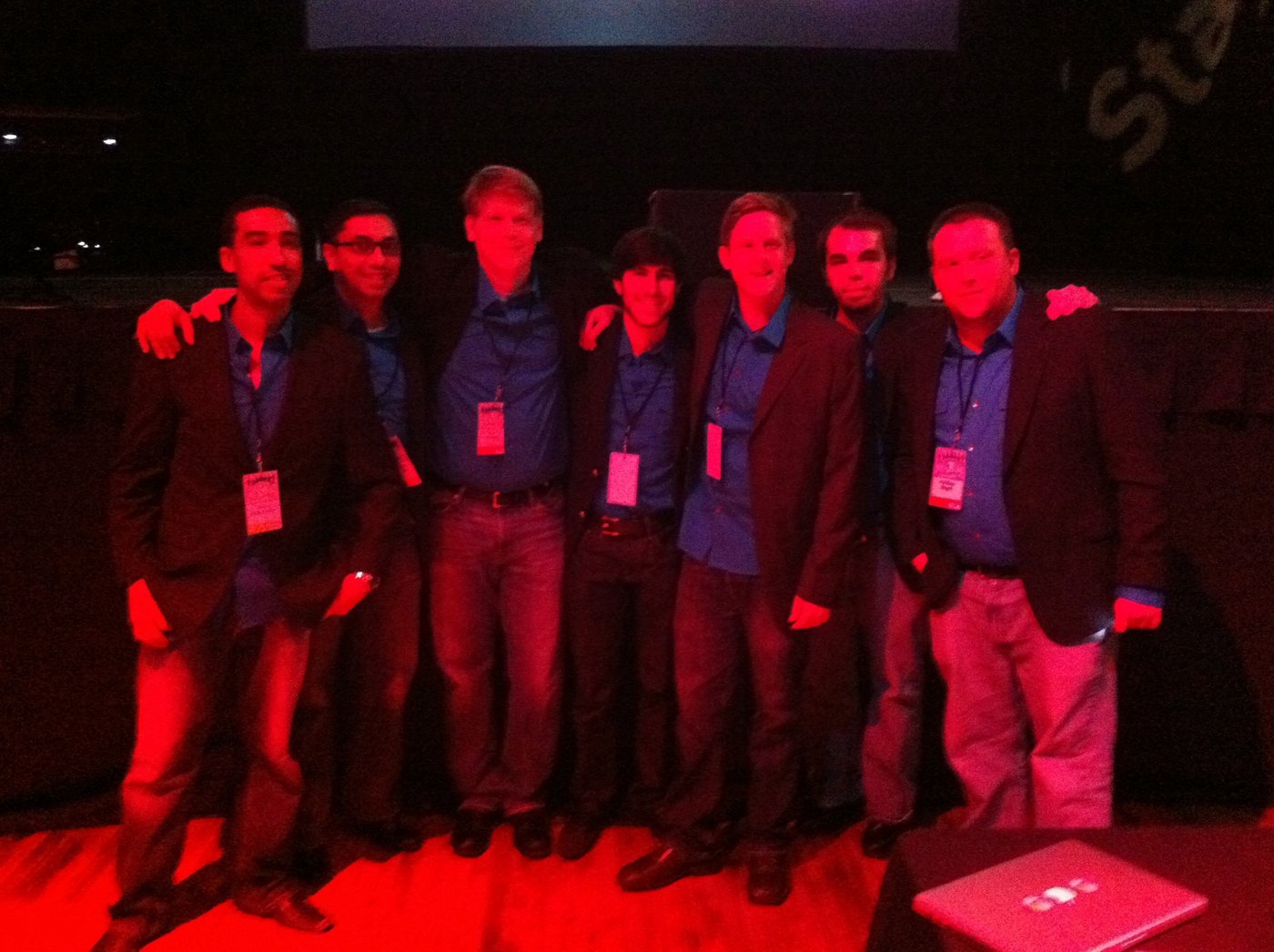
The early seven-person team included Ross Rankin, Pratik Patel, Vince Baskerville, James Martin, Katie Elizabeth, Dan Nussenbaum, and me. Across engineering, design, product, operations, and marketing, they supplied the range of talent required to turn the idea into a company.
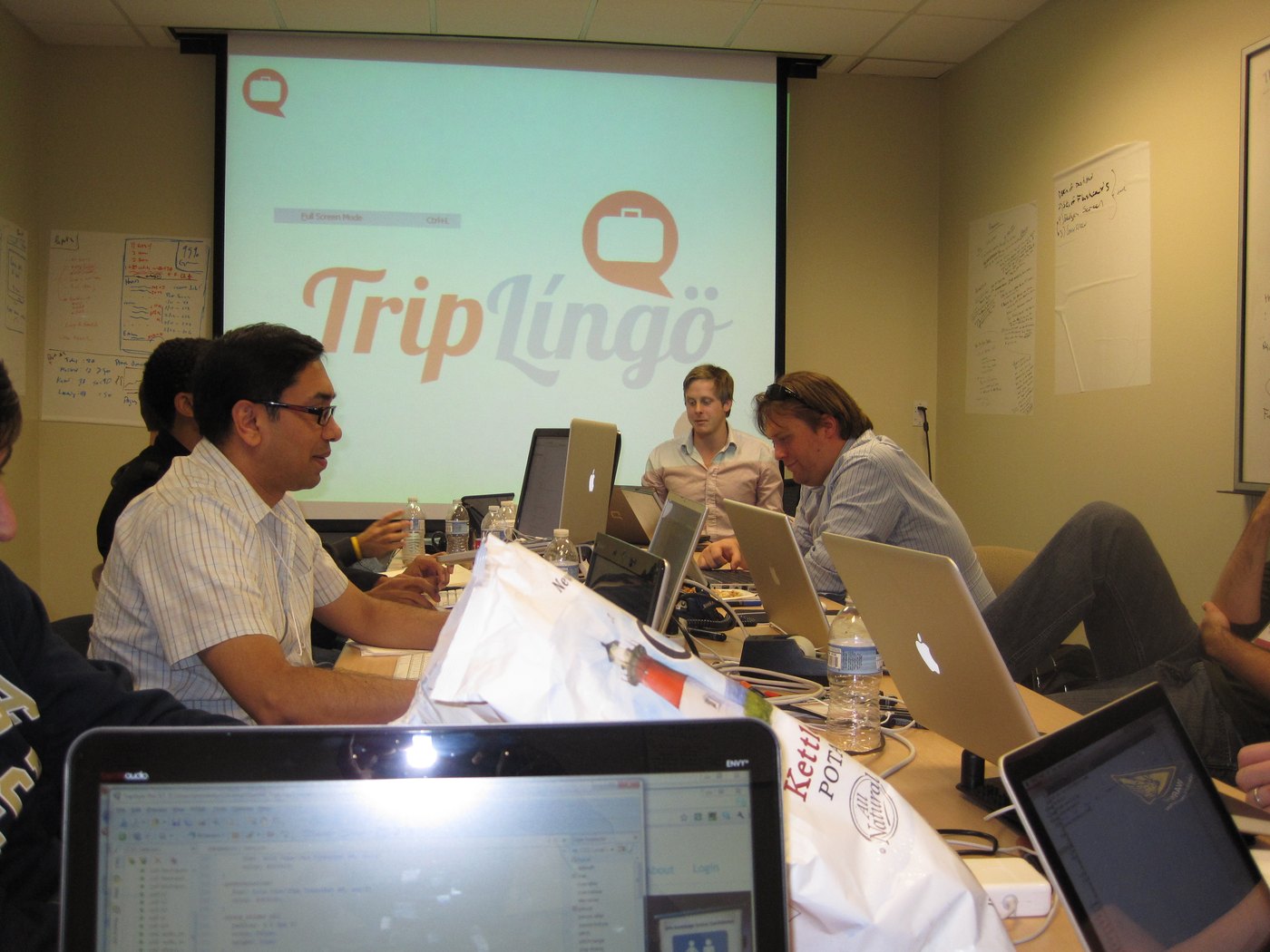
I had carried the idea around for the better part of a year. A company only existed once six other people decided to build it with me.
A month later, TripLingo competed at Startup Riot and finished first among 50 companies. CNN and the Atlanta Journal-Constitution covered the company. We raised early funding from friends, family, and angel investors, and kept building.
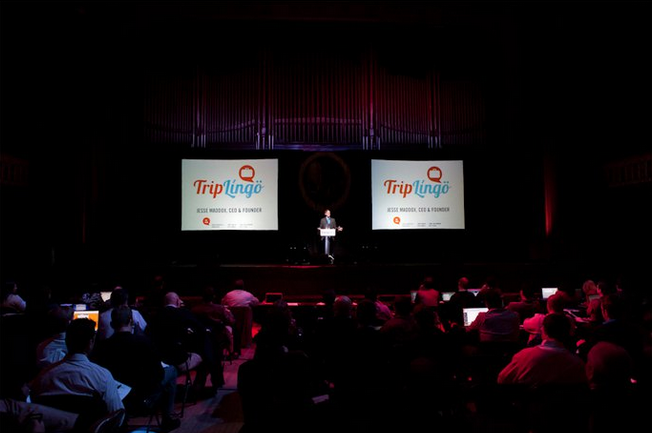

On May 5, 2011, Cinco de Mayo, we launched TripLingo in Apple's App Store with five languages. The next day I posted it to Hacker News, offered a handful of promo codes, and asked strangers on the internet to tell us what they thought.
Throughout the rest of 2011, we added seven more languages. TripLingo expanded to iOS and Android, with versions also reaching the Nook and Kindle Fire. We released a free Dari edition for American troops in Afghanistan.
The product grew beyond flashcards and phrases. It taught formal, casual, slang, and sometimes deliberately ridiculous ways to say the same thing. It added pronunciation guides, professionally recorded audio, dictionaries, cultural notes, etiquette guidance, voice and image translation, safety information, and tools for avoiding international calling and roaming costs.
The underlying purpose remained the same: help people navigate unfamiliar places and create interactions that otherwise might not happen.
The business changes shape
We initially built TripLingo for individual travelers. As the product reached the market, however, we began hearing from business travelers, travel agencies, travel management companies, and employers.
Their needs overlapped with those of leisure travelers, but they also went further. Companies wanted to help employees stay safe abroad. Travel managers cared about duty of care, emergency information, communication, and cost control. Travel providers wanted a better experience for their customers and, in some cases, a product tailored to their brand.
So we went where they pulled us.
In 2012, at the Global Business Travel Association Convention in Boston, TripLingo won the GBTA Business Travel Judges' Award, the top judges' prize in that year's Business Traveler Innovation Awards.
I remember calling the team back at the office with the news. A few hours later, I accepted the award before a convention audience of nearly 7,000 travel professionals, shortly before George W. Bush took the stage.
The award was gratifying, but its larger significance was that it pointed toward a market we were only beginning to understand.
By 2013, TripLingo had passed 200,000 downloads. We also began working more deliberately with enterprise customers and travel agencies. A partnership with Celebrity Cruises produced a cruise-specific version of the product, one example of how a consumer app could become part of a larger travel experience.
This did not happen because the original idea was wrong. It happened because the idea encountered real customers, and those customers showed us where it could become more useful.
In November 2014, Travel and Transport integrated TripLingo's content and functionality into its eTTek Dash mobile app. International travelers using Dash could access country information, local phrases, audio, cultural guidance, and safety content connected to their trips.
That integration became an important relationship. TripLingo remained part of Dash for several years through an API while we continued serving our own users, enterprise customers, and travel partners.
The middle years deserve a sentence of honesty. Between the 2014 version of this story and the sale came the unglamorous stretch every eight-year company has: enterprise sales cycles measured in quarters, renewals, integrations, and the slow acceptance that our future was business travel rather than backpackers. Nobody writes “we're just getting started” about year seven. We kept building anyway.
The company that began as a way to help an individual traveler learn a little local language had become part of the infrastructure used to support corporate travelers.
The partner becomes the buyer
On May 13, 2019, Travel and Transport announced that it had acquired TripLingo.
The acquisition came a little more than eight years after the team formed in Atlanta. It placed TripLingo inside a larger travel organization that already knew the product, had used its technology, and wanted to integrate it more deeply into its platform.
The transaction did not mark the end of the work. I joined Travel and Transport and spent the next four years in the corporate travel ecosystem. Travel and Transport later became part of Corporate Travel Management, and the setting changed again.
That continuity is part of the story. An acquisition is often described as a finish line because it gives the narrative a clean ending. The reality here was more ordinary and more useful: ownership changed, the organization changed, and the work continued.
What remained
I used to close this story with a list of lessons when I gave it to MBA students at the University of Georgia. Those slides are about ten years old now. I have not revisited them since, and I built all of it before AI changed what two people can do in an afternoon. Most of them have held up anyway.
The one I leaned on hardest was also the least original: if you build it, they will not come. My slide was the cornfield from Field of Dreams with WON’T stamped across it in red, and I put it there because I needed the reminder more than the students did. Our early plan assumed that a good enough app would find its own travelers. It did not. What moved the numbers was the slow, unglamorous work of partnerships, and it stayed slow for a long time. One agency partner became twenty-seven over about sixteen months, and the travelers those partnerships represented climbed into the millions. Drawn on a chart, that looks like a hockey stick. Lived through, it was a long flat stretch where nothing appeared to be working, followed by compounding we could not have forced any sooner.
The other one I would keep is that incremental is not a strategy. I used to put a horse-drawn carriage next to a Model T. The point was not that new things win. It was that being somewhat better than what people already use is not a reason for anyone to change what they do. Two syllables of Vietnamese was not a better phrasebook. It was a different experience.
The rest is less lesson than fact. Raising money was hard every single time. Every plan we had held up right until it met an actual customer. And several of the best things that happened to us, including the partnership that eventually became the acquisition, came from luck I did not engineer and cannot take credit for.
The timing of the sale is the clearest case of that. We closed a week before my first child was born, and less than a year before COVID shut down international travel. A company whose whole premise was helping people function in places they had never been would not have survived the panic that followed. That had nothing to do with how well I ran anything, and our investors got the benefit of it too. Sometimes it is better to be lucky than good.
What I would add now, because it was not on any slide: the idea kept its purpose while changing shape far more than I expected, and it was never mine alone. I carried the concept by myself for months, but there was no company until people with skills I did not have chose to build it with me. The product, the partnerships, the funding, the awards, and the sale were all collective. The work did not stop at the acquisition either. TripLingo moved into a much larger organization and I moved with it, and the four years that followed belonged to the same arc, even though the founder chapter had closed.
TripLingo eventually accumulated versions, platforms, partnerships, customers, awards, and an acquisition. But its first useful moment required only two syllables.
No fluency. No perfect conversation. Just enough language to turn an uncomfortable interaction into a human one.
The company changed shape many times after that. The premise did not.